
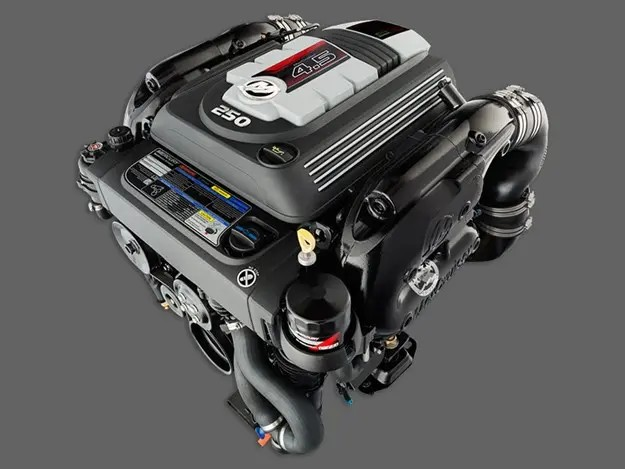
Review: MerCruiser 250 Stern Drive 4.5 V6 Marine Engine
The MerCruiser 250 Stern Drive is a logical successor to the popular V6 4.3. In both carbureted and EFI form, the MerCruiser 4.3 was an incredibly popular engine. A V6 version of the long-running 5.7-litre V8, it was compact, easily serviced, and reliable due to its inherently simple design. And for boaters who just wanted to potter around rivers and bays, the freshwater-cooled models were brilliant.
The freshwater cooling maintained relatively constant engine temperatures, even under low engine loads such as when trolling, whereas the raw-water cooled models suffered fuel blow-by past the piston rings—literally washing away lubricating oil on the cylinder walls and diluting oil in the sump.
Sure, electronically injected diesels are way more tolerant of low loads than mechanically injected engines, but they are still more likely to suffer glazed cylinder walls than comparable output freshwater-cooled petrol engines.
The Mercruiser stern drive, released almost four years ago, scores over its diesel competition. It also has the same footprint as the 4.3, so it can easily be fitted in hulls such as the Caribbean 26 when it comes to re-powering.
The multipoint EFI also incorporates Mercury's clever Adaptive Speed Control, where the engine maintains a set rpm in varying sea states and through turns by sensing increasing engine load and injecting more fuel to compensate.
The Nitty Gritty
Compared to diesel stern drives such as the MerCruiser TDI 3.0L, the V6 4.5 is a throwback to much older engineering, even though it was released so recently. It has only two valves per cylinder, operated via rockers and push rods from the central camshaft. It has a harmonic balancing shaft fitted to overcome the imbalance inherent in a 90-degree V6 engine. The 4.5 has the same bore and stroke as the now-discontinued MerCruiser 3.0-litre petrol stern drive and the same bore as the MerCruiser 6.2-litre V8, so finding components like pistons in remote regions shouldn't be an issue.
The construction is all cast iron so the engine could be run with just raw water cooling, as is standard with the Alpha drive leg, but as freshwater or heat exchanger cooling benefits outweigh raw water, in my opinion, it would be foolish to go down this track. Freshwater cooling adds around 24kg to the dry engine/drive weight and is mounted ahead of the engine for easy access to the header tank.
A serpentine belt drives the alternator, power steering pump, and raw and freshwater circulating pumps. This design makes belt changing easier than separate belts in some automotive engines, where up to two or three different belts are used, depending on whether air conditioning or power steering are fitted. Having the belt load close to the crankshaft drive pulley also reduces side loads on the crankshaft itself.
The 70-amp alternator has voltage regulation and is mounted well above the crankshaft pulley. The engine oil filter and sump dipstick are mounted at the forward end, though owners would need to be quick to remove and install a new filter, seeing as it's inverted. Mercury recommends servicing intervals of 20 hours, then 100 or annually with Quicksilver FCW (Four Cycle Water Cooled) SAE 25W40 synthetic blend oil used year-round.
Like all MerCruiser stern drives from 2015 onwards, the 4.5 is available with Mercury Marine's Axius control, which splays out the Bravo 3 legs to position the hull where wanted. With twin counter-rotating props, the traditional one ahead/one astern technique never worked with Bravo 3 drives, unlike Alpha drives, which unfortunately lacked prop pitch and blade area to effectively perform this technique in anything rougher than a calm sea. Bravo 3 drives always had plenty of bite, but putting one engine ahead and the other astern crabbed the boat sideways. In fact, the Bravo 3 provided more manoeuvrability in single installations than in twins before the advent of Axius.
Simply twisting a small knob on the dashboard allows a boat to be controlled easily without thinking, great for amateur boaters. Again released in 2015, Mercury Marine's Skyhook enables a boat to be dynamically positioned using GPS coordinates. Two modes are available, but the docking mode still provides good control entering a marina with less aggressive shifting between ahead and astern gears. I would dearly love to try Axius in a Caribbean 26. Even in twin inboard installations, Caribbean hulls have a tendency to wander astern unless the one ahead/one astern technique is used, so Axius would transform stern drive-powered hulls into predictable handling boats in a marina.
Mercury Marine also offers a 200 HP version of the 4.5 V6, but this is mated only with an Alpha drive and suits single installations in trailer boats. Axius and Skyhook only work with
twin installations.
Despite its way larger piston displacement than the MerCruiser TDI 3.0L diesel, the 4.5 V6 250 is 231mm shorter, 73 narrower and a whopping 294mm lower, so for re-powering a hull like the Caribbean 26. The 4.5 will fit wherever the 4.3 V6 did, whereas the engine box will need major modifications to accommodate twin TDI 3.0L engines. When I tested these in a Caribbean 26, six years ago, the box modifications encroached a lot on cockpit space, but then they did push the hull to almost 40kts compared to 32 for the twin 4.3 V6 engines fitted initially. I estimate the additional torque and power of the 4.5 V6s over the 4.3 engines would give a 26 around 34kts at Wide Open Throttle.
On-Water Test - An Exceptional Driving Experience
Tested in a Sea Ray 310 Sundancer, the twin 4.5s provided all the performance a family would need with excellent cruising speeds and midrange fuel efficiency. The 310 is also available with twin MerCruiser 6.2 stern drives, but frankly, in a boat like this, it would be overkill.
The 4.5s started instantly, hot or cold, with low noise levels—only 62dB at 600rpm. There was a very slight rumbling through the hull structure, and surprisingly, noise levels were slightly higher than those of a single MerCruiser 3.0L diesel I also tested that day in a Sea Ray 250 bow rider. But this could have been the effect of having twins aboard instead of a single.
Using the Axius, we easily handled the marina confines with a level of control not possible with just twin Bravo 3 drives on their own. Once warmed up, we opened the throttles with the trim tabs in neutral plane and planed at only 3,000 rpm, just below where I estimate maximum torque comes in. As I've stated many times, real planing fuel efficiency is only achieved when a hull planes below the engines' maximum torque zones.
Apart from the lovely V6 exhaust note, as the engines loaded up coming out of the hole, they were very quiet, with most of the noise coming from the drives with their two right-angle gears.
Adaptive Speed Control
Through tight turns up to 4,000 rpm, the Adaptive Speed Control maintained constant revs without touching the throttle, making driving the boat much more pleasant than juggling the throttle levers to maintain cruising rpm. With full fuel and three adults aboard, the 4.5s reached right in the middle of the recommended WOT rpm range, and we could still talk normally at the helm.
The Wrap
In my opinion, petrol stern drives like the 4.5 are perfect for boaters who want to sprint to a favourite cruising area, then potter around at fast idle and not worry about possible cylinder wall glazing. Another benefit is that these engines are so simple to maintain and repair compared to their turbo diesel counterparts. Although the 4.5 was designed as a dedicated marine engine, it has a traditional automotive design that most old-school mechanics know how to work on.
For the location of your nearest MerCruiser dealer Google Mercury Marine stern drives,
Click on Find a Dealer, then enter your suburb and postcode.
Performance and Fuel Consumption
Twin 4.5 V6 stern drives in a Sea Ray 310 Sundancer with Bravo 3 drives swinging 22.5-inch pitch props. The total displacement is 5.8t, including full fuel and three adults. Average of two-way runs on Biscayne Bay, Miami, over a low chop. Range is in nautical miles for the 470L tank with a 10% reserve.
|
Rpm |
Kts |
L/h Total |
Range |
DB at 3 metres |
|
1000 |
2.4 |
12.1 |
767 |
70 |
|
2000 |
5.3 |
28.4 |
79 |
76 |
|
3000 (planing) |
17.4 |
54.1 |
136* |
82 |
|
3500 (cruise) |
24.4 |
77.6 |
133 |
83 |
|
4000 (max cruise) |
33.1 |
121.9 |
115 |
84 |
|
5000 (WOT) |
37.4 |
155.2 |
102 |
90 |
* Note: unlike diesel engines, maximum fuel efficiency is when planing.
Quick Specifications
Engine Type: 90 degree V6 EFI four-stroke petrol
Rated BHP/MHP: 249.3/252.9 at 5,000rpm
WOT Range: 4,800 to 5,200rpm
Displacement: 4,500cc
Bore x Stroke: 101.6 x 91.4mm
Dry Weight: w/Bravo 3
Raw Water Cooled: 438kg
Freshwater Cooled: 462kg
*Brake horsepower/metric horsepower or PS
This review was originally published in issue #509 of Trade-a-Boat magazine.
Ready to Set Sail?
Find your dream boat online at Only Boats! We have great deals on boats for sale, including used boats and new boats. You can also check out our used boat buying guide.
If you're upgrading or planning to sell your boat, why not explore our expert guide on how to improve boat resale value. If you're planning to attend a boat show soon, we've also put together a detailed boat show buying guide that's perfect for first time buyers.
Smooth sailing starts with the right boat. We’re here to help you find it!
This article was written by Andrew Norton, photos provided by Editorial Team and previously appeared at TradeaBoat.com.au, now powered by Only Boats.
Getting boat finance sorted shouldn't be the hard part of boat ownership. Credit One has helped thousands of Australians get on the water, earning a reputation as Australia's best-reviewed finance broker with 3,000+ glowing Google reviews to show for it. See what customers have experienced by reading their Credit One reviews, or use the loan repayment calculator to work through your options.