
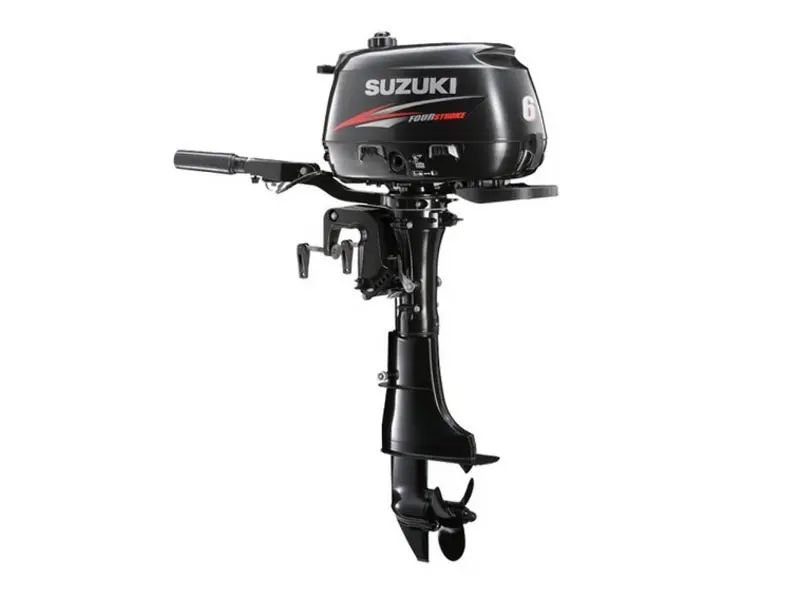
Suzuki DF6 Portable Outboard Motor Review
It's hard to believe it’s been 13 years since I commenced a long-term evaluation of a portable Suzuki DF6 outboard motor. The engine has stood still while the competition has offered more features, yet quirks aside, it still has a lot going for it.
Released on the Aussie market in late 2002, the DF6 scored over its Mercury F6 portable outboard competition, with its 12 per cent greater piston displacement, allowing it to develop the same power at lower revs. It also had two shallow-water drive settings for skinny water operation instead of one, and a much larger integral fuel tank in addition to the remote tank. And its massive 0.7-litre sump capacity handled oil dilution during extended trolling periods way better than the Merc’s 0.45-litre sump.
Suzuki didn’t fit a low-oil warning light for the pressure lubrication system on the portable DF6 outboard, so if oil pressure dropped, you’d only know when the engine seized. The cooling water intake located directly under the anti-ventilation plate didn’t have a cleanable screen, so chunks of weed cut up by the prop could actually clog the water pump impeller. More recently, while Mercury Marine upgraded its F6 outboard with an upfront gear shift, Suzuki persisted with a side shift.
Like the Mercury engine, the Suzuki DF6 outboard engine has gear-driven pushrods operating the rocker gear and two valves. The carburettor is atop the cylinder with the exhaust below, creating a cross-flow cylinder head. An effective thermostat warms the engine quickly from cold and maintains fairly constant temperatures even in mid-winter. The electronic ignition timing advance eliminates the need for mechanical linkages and enables the use of premium unleaded (95 RON) as well as standard (91 RON). E10 can also be used, but why put what’s essentially weedkiller in an engine? In my opinion, governments should be drawn and quartered for allowing this crap to be sold.
The vanes on the flywheel, which cool the ignition coil via a shroud, are a nice touch. An optional 12-volt, 6-amp unregulated alternator is also available.
Two fuel filters between the integral and remote fuel tanks stop most contaminants from reaching the carburettor, and the 1.5-litre integral tank gives a good operating range without having to use a remote. Five trim positions and automatic full tilt and reverse locks are provided. Suzuki even supplies transom bolts for permanent mounting.
The chromed rocker cover looks great compared to the painted cylinder and block, and gives quick access to the rocker gear for valve clearance adjustment.
Maintenance and Servicing
The sparkplug is a standard automotive unit available in most auto spares shops, but oil changing is messy as the sump drain plug is directly under the sump and dumps oil everywhere when removed.
I recommend changing the oil every 100 running hours or six months after the first service at 20 hours. From new I’ve used Quicksilver FCW SAE 10W30 oil in my Suzuki, simply because I believe it’s the best four-stroke outboard oil available.
Prop swapping is easy: remove a cotter pin, and the prop slides off. Venting exhaust gases above the prop when going astern on a shallow water drive setting gives the prop more bite than a through prop hub exhaust, useful for backing out of skinny water.
On the Water
My Suzuki DF6 portable outboard motor has been used on six hulls, ranging from a three-metre flat-bottomed punt to auxiliary power on a 4.3-metre Clark runabout normally powered by a Suzuki DF40, but the best performance has been on my 2003 flat-bottomed Sea Jay 3.4 Punt. This has all-welded construction with 1.6mm bottom and topside sheeting and six chunky transverse frames.
The standard 7.5x7 in alloy prop provides very good performance, although the DF6 isn’t as quick on this hull as the current-model F6 I reviewed last year. The main reason is that when propping for a planing hull, the prop pitch must always be greater than the diameter, otherwise there’s excessive blade drag. Matched to its deep 2.15:1 gear ratio, the F6 runs a 7.8x8 in prop, enabling the engine to rev well out while pushing two adults and fishing tackle. However, the Suzuki DF6’s portable outboard motor’s prop drags and reduces wide-open throttle speed, while the bigger displacement power head uses more fuel.
However, there is a positive side to the Suzuki outboard’s propeller design: it slips more under heavy loadings than the semi-weedless prop fitted to the F6, allowing the Suzuki DF6 to push heavier loads. For example, when pushing a total of 330kg, the DF6 still reached the bottom of the recommended WOT rpm range, even though the hull wasn’t planing. Not that I advise anyone to treat a four-stroke outboard this way.
The DF6 vibrates more than the F6 above half-torque opening, and on long runs, it gives my copious arm flab a good workout. It’s also noisier than the F6 because of the above-prop exhaust.
The Suzuki DF6 portable outboard motor is definitely not an oil burner. Over the first 50.4 hours, averaging 0.55 L/h and 7.5 per cent WOT operation, it had a fuel/oil ratio of 1250:1. From 50.4 to 72 hours with the same WOT percentage, this improved to 2500:1, and from 72 to 94.2 hours, it delivered 4000:1—incredibly impressive for a small four-stroke.
However, after 250 hours of saltwater leg/lower unit immersion, the leg has extensive paint bubbling despite the anode being replaced. Also, the absence of a cooling-water intake screen has meant three new water pump impellers. Also, the leaking fuel pump will need to be replaced.
Our Verdict
My Suzuki DF6 portable outboard motor is showing its age, and frankly, an upfront gearshift and a water intake screen wouldn’t go amiss. But it is the lightest of all the portable four-stroke sixes, and its well-placed carry handle makes toting this engine any distance tolerable. Also tolerable are vibration levels that reduce flab without causing numbness.
Suzuki DF6 Sea Trials
Single Suzuki DF6 portable outboard motor on Sea Jay 3.4 Punt, 7in prop, total 290kg including two adults and fishing tackle. Average of two-way runs on Lake Macquarie, NSW, using handheld GPS, high-tension lead tachometer and in-line fuel flow equipment.
1200rpm reaches a speed of 2.3kt with fuel burn of 1.9L/hr and economy of 0.16L/nm
5000rpm reaches a planing speed of 12.1kt with fuel burn of 0.2L/hr and economy of 0.09L/nm
5700rpm (WOT) reaches a speed of 15.1kt with fuel burn of 2.6L/hr and economy of 0.17L/nm
Cruising loop (averaging 4.0kt with 10 per cent WOT) gave 0.58L/h. Increasing the total load to 330kg reduced the WOT average to 8.5kt at 4900 rpm, and the fuel flow rose to 0.84L/h.
Suzuki DF6 Specs
Engine Type: Single-cylinder four-stroke petrol portable outboard motor
Rated BHP/MHP*: 5.9/6.0 at 5250rpm
Rec. WOT Range: 4750 to 5750 rpm
Displacement: 138cc
Bore x Stroke: 62x46mm
Gear Ratio: 1.92:1
Weight: 25.0kg (dry, short shaft)
OEDA stars: 3
* Brake horsepower/metric horsepower or PS.
Ready to Set Sail?
Find your dream boat online at Only Boats. We have great deals on boats for sale, including used boats and new boats. You can also check out our used boat buying guide.
If you're upgrading or planning to sell your boat, why not explore our expert guide on how to improve boat resale value. If you're planning to attend a boat show soon, we've also put together a detailed boat show buying guide that's perfect for first time buyers.
Smooth sailing starts with the right boat. We’re here to help you find it!
This article was written by Andrew Norton and previously appeared at TradeaBoat.com.au, now powered by Only Boats.
Getting boat finance sorted shouldn't be the hard part of boat ownership. Credit One has helped thousands of Australians get on the water, earning a reputation as Australia's best-reviewed finance broker with 3,000+ glowing Google reviews to show for it. See what customers have experienced by reading their Credit One reviews, or use the loan repayment calculator to work through your options.